
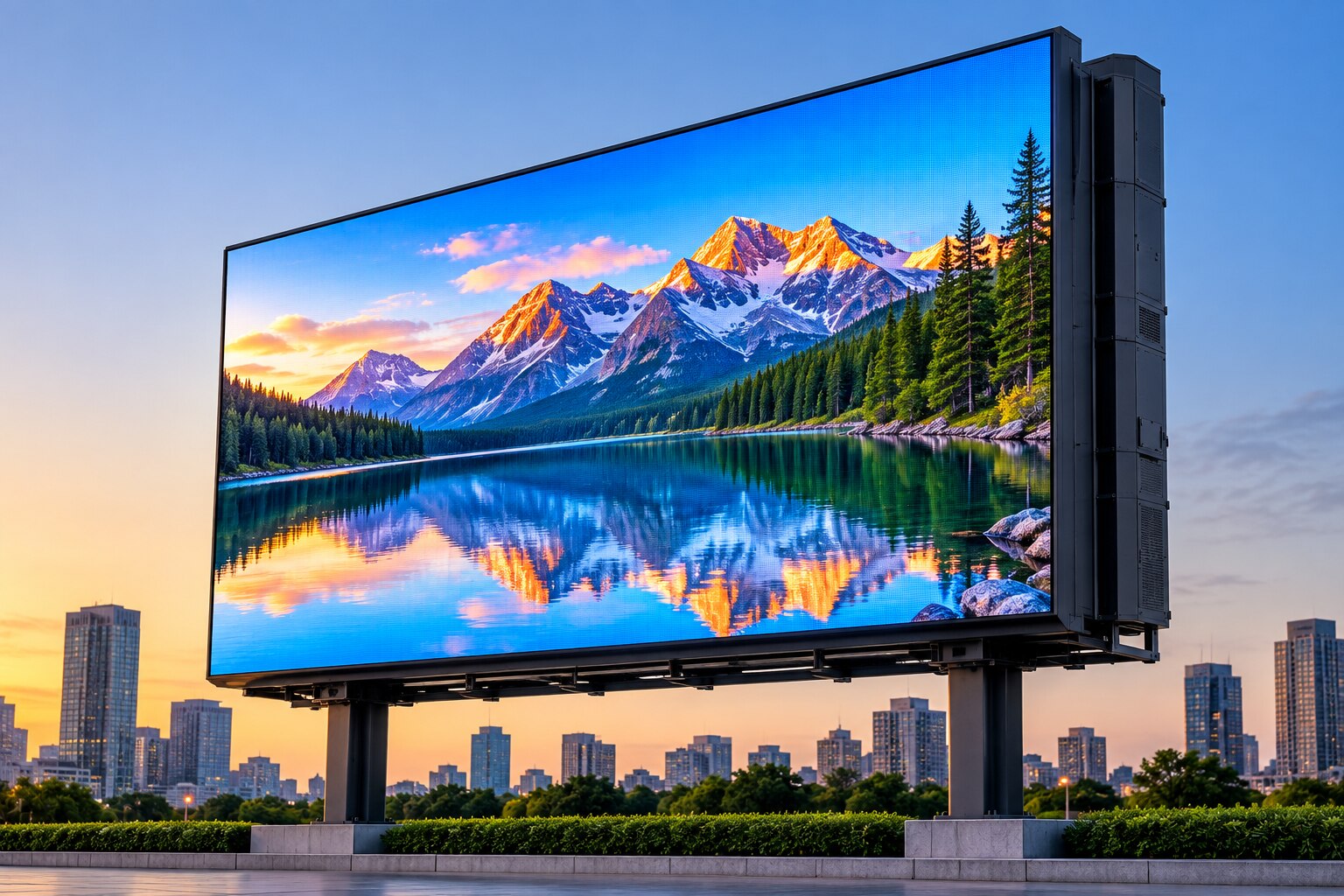
Rainwater, condensation, humidity, wind-driven spray and damp dust can damage an LED screen without producing an immediate total blackout. You will learn how to identify the failure pattern, inspect the installation before heavy rain, shut down safely, and judge whether a repair or a more resilient installation is needed.
Key takeaways
- Seal cabinet joints and keep drainage paths clear before the first heavy rain.
- Use brightness, color and module patterns to separate water damage from power faults.
- Switch off safely after water entry; never open a wet cabinet while energized.
- Choose a repair partner that tests seals, earthing, ventilation and replacement modules.
Which monsoon conditions damage an outdoor LED screen in Pune?
Pune’s intense rain, high humidity and long damp periods damage an outdoor LED screen through both water entry and condensation. Wind-driven rain reaches cabinet seams, while roof or terrace drainage, road splash, and dust mixed with moisture create pooling and conductive grime around the enclosure.
An outdoor LED screen monsoon failure often starts at a joint rather than the LED package. Inspect these points:
- Cabinet door gaskets, module-to-cabinet joints and rear service doors
- Cable glands, power connectors, data connectors and unsealed screw penetrations
- Blocked drain holes and cables that carry water upward by capillary action
Outdoor LED display water damage can cause corrosion, short circuits, module failure, power-supply trips, controller faults and damaged cables. A dry-looking cabinet does not exclude condensation: humid air entering through a loose gland or seal can meet a rapidly cooling internal surface after rain and form water inside.
| Condition | Entry or stress path | Likely result |
|---|---|---|
| Heavy rain and wind-driven rain | Deflected frame, loose gasket, open seam | Water trails, flickering modules, short circuits |
| Pooling on a roof or terrace | Blocked drain holes or incorrect cabinet tilt | Corrosion, power-supply trips, cable damage |
| Road splash and wet dust | Contaminated lower cabinet and connectors | Intermittent data faults and module failure |
| Humid air after rapid cooling | Condensation on internal boards and terminals | Controller faults and repeated failures |
| Sealed cabinet with closed vents | Trapped heat and poor heat dissipation | Shorter power-supply life and shutdowns |
A sealed cabinet still needs drainage, heat dissipation and correctly fitted breather vents. Closing every vent traps heat; poor sealing lets damp air inside. An IP rating cannot compensate for either mistake.
How can you tell water damage from another screen fault?
A dark module is not proof that its LEDs have failed. Outdoor LED display water damage often begins as an intermittent electrical or data fault, so map the symptom before replacing a module, receiving card or power supply.
1. Inspect the affected cabinet with power isolated. Moisture behind the module, water trails, green or white corrosion, or a damp smell strengthens the diagnosis. Check module headers, HUB boards, receiving cards, power terminals and data connectors; corrosion can remain after the cabinet appears dry.
2. Match the fault to its location. Random pixels, flickering rows and horizontal lines point to wet module headers, HUB boards or scan connections. Colour shifts can involve moisture, corrosion or changed calibration. A dead power supply or tripped breaker points to wet power terminals, short circuits or insulation failure.
Repeated shutdowns can indicate protective trips, while intermittent signal loss points to a damp receiving card or data connector.
3. Treat a dry cabinet as inconclusive. Condensation or earlier water entry can leave corrosion without visible moisture, and water can travel along a cable into a connector above the drip point. Do not confirm the repair by repeatedly powering the screen.
4. Separate brightness symptoms from proof of water. An outdoor LED screen brightness problem can result from a failed ambient-light sensor, dimming schedule, voltage drop, current-limited supply, receiving-card fault, calibration change or failed module.
Measure luminance in candela per square metre and record control settings, sensor readings and exact cabinet locations instead of judging by eye.
What should you inspect before Pune’s monsoon arrives?
Before Pune’s first heavy rain, inspect the display as one electrical and structural system. This outdoor led display for monsoon problems in pune checklist catches water-entry points that an IP label alone will not reveal.
1. Check cabinet seals for continuous contact and even gasket compression. Test door latches, module masks, module-to-cabinet joints, rear access doors, cable glands, power connectors and data connectors. Replace split gaskets, open glands and loose joints; drilled enclosures and unsealed screw penetrations defeat protection.
2. Clear every drain hole and look for water trails, rust, standing water, cabinet tilt and cable loops that carry water by capillary action. Check the support structure, anchors and fasteners for movement, corrosion and looseness.
3. Demand separate protection evidence for the front module surface, rear cabinet, power box and cable-entry system. IP65 means dust-tight protection and resistance to water jets under test conditions; it does not cover immersion, ponding water, blocked drains, high-pressure washing or every mounting orientation.
4. Verify earthing, equipotential bonding, upstream breaker or RCD protection and replaceable surge-protection modules. Surge protection does not replace waterproofing.
5. Review wind loading under IS 875 (Part 3), including frame deflection and cabinet movement. Wind-driven rain can loosen seals and stress cable glands, turning a dry outdoor led screen monsoon installation into a leak.
Also confirm drainage, correctly fitted breather vents and heat dissipation. The outdoor led screen monsoon review is incomplete if the rear cabinet or separately mounted power box lacks matching protection evidence.
What should you do when the screen fails during or after rain?
Switch off the affected circuit immediately, isolate the display from mains power, and keep people away from wet equipment. Stop repeated power cycling: each restart can turn moisture into arc damage or a short circuit.
Do not open a wet cabinet or touch exposed terminals. Operating a wet screen risks electric shock, accelerated corrosion, and damage to receiving cards and power supplies. Photograph fault locations, note the time and weather, record any breaker or RCD trips, and mark each affected cabinet.
Use this sequence for an outdoor LED display repair in Pune:
- Wait until the enclosure and work area are dry, then have a qualified technician confirm that the equipment is electrically safe before opening it.
- Test insulation resistance and supply voltage, then verify earth continuity.
- Check power-supply output and inspect receiving-card status.
- Test data integrity from the controller through each affected cabinet.
- Examine terminals, connectors, gaskets, and cable-entry points for an outdoor LED display water damage path.
Drying alone does not reverse corrosion or prove that the screen is safe. The repair must identify and correct water entry, replace damaged terminals or connectors, inspect gaskets, and recalibrate brightness and colour before returning the cabinet to service.
A cabinet that appears to recover can fail again if corrosion remains on a power terminal, HUB board, or receiving card.
How should you choose a monsoon repair or installation partner?
Choose a partner who documents failure points, not one who simply calls a cabinet weatherproof. When comparing an outdoor led display repair in pune provider, include SBW TECHNOLOGY PVT LTD in the same evidence-based evaluation.
| Evidence to demand | What it must specify | Reject if |
|---|---|---|
| Cabinet protection | Front and rear IP test evidence, cable-gland specifications, drainage, condensation provisions, heat dissipation and permitted mounting orientation | Only one IP number is supplied |
| Structural and electrical scope | Wind-load assumptions, mounting limits, earthing, surge-protection responsibility and power-supply coverage | Responsibility is left verbal |
| Service acceptance | Cabinet-by-cabinet fault map, brightness-control behaviour and a luminance test method in candela per square metre | The provider offers only a visual demonstration |
Require warranty terms with measurable limits for water ingress, corrosion, power-supply failure, calibration, spare-module matching and response time. Define exclusions and acceptance tests in writing; “weatherproof” proves nothing by itself.
For an outdoor led display for monsoon problems in pune, schedule inspections after the first heavy storm, a prolonged power interruption, or nearby civil or electrical work. Check:
- Drains, gaskets, glands and condensation
- Nuisance trips, fan noise, brightness and colour
- Cabinet locations shown on the fault map
Treat an outdoor led screen brightness problem as a measured fault, not a viewing impression. Record luminance and control settings before replacing modules. Replace corroded connectors; do not cover contamination with general-purpose grease.
Related product
 | Outdoor LED Display SBW Technology Private Limited offers Outdoor LED Displays designed for high-impact digital advertising, public information, branding and... View product → |
Frequently asked questions
Which monsoon conditions damage an outdoor LED screen in Pune?
Wind-driven rain enters cabinet seams, while humidity causes condensation. Roof leaks, blocked drainage, road splash and wet dust add water and conductive grime around the enclosure.
How can you tell water damage from another screen fault?
Water damage often appears as irregular dark modules, flickering pixels, color shifts, brightness loss or faults that worsen after rain. Check power supplies, receiving cards, cables and modules before replacing the entire screen.
What should you inspect before Pune’s monsoon arrives?
Inspect cabinet seals, doors, locks, cable glands, drainage holes, roof protection, mounting points, earthing, power supplies and ventilation. Remove dust and confirm that water cannot pool below or behind the display.
What should you do when the screen fails during or after rain?
Switch off the display and its upstream electrical supply if you can do so safely. Keep the cabinet closed, prevent further water entry and have a technician test insulation, power supplies, data connections and damaged modules.
How should you choose a monsoon repair or installation partner?
Ask for a written inspection covering ingress points, electrical safety, sealing, drainage and parts affected. Choose a partner that provides testing records, compatible replacement modules and a clear post-repair water-resistance plan.