
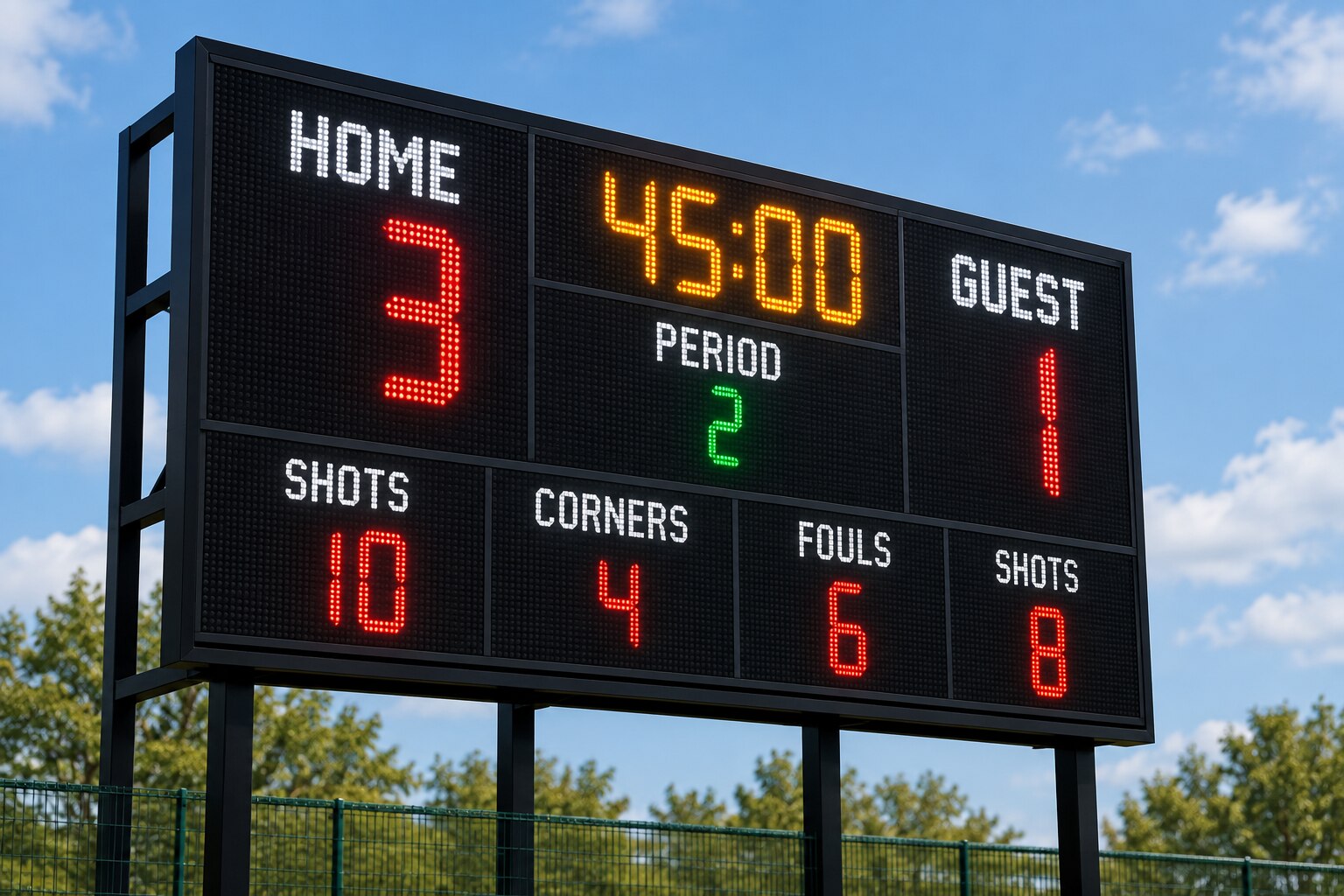
A reliable scoreboard starts with viewing geometry, weather exposure, electrical capacity and sport-specific scoring data—not with screen size alone. By the end, you will be able to survey a Pune ground, choose suitable display and control specifications, plan the installation, and verify the finished system before handover.
Key takeaways
- Measure every viewing point before selecting cabinet size or pixel pitch.
- Match the scoreboard data system to the sport and scorer’s workflow.
- Specify outdoor brightness, weather protection, ventilation and surge protection.
- Record wiring, settings, spares and operating steps at handover.
Measure the Ground Before Choosing the Scoreboard
Measure from the actual viewing points before you order a cabinet. For LED scoreboard installation for sports grounds in Pune, record the farthest and nearest spectator positions, scorer’s table, player area, camera locations, boundary line and any road-facing sightline.
Mark the angle of direct afternoon sun; glare can make white numerals unreadable even when the display has sufficient brightness.
Use the survey to establish these design inputs:
- Measure distance and elevation from each important viewing point to the proposed screen centre, then check whether roof edges, poles or trees block the sightline.
- Set numeral height from the farthest seat, not from the available wall. Test the intended score, timer and team names at full scale.
- Measure the available width and height, including service clearance behind and beside the cabinets. Separate the active scoring area from space reserved for video, advertising or replays.
- Record camera-to-screen angles. Moiré, refresh-rate problems and reflections can affect televised footage even when spectators see a clear image.
- Survey the proposed foundation, mounting height, access route and wind exposure. Steelwork, anchors and foundations require calculations under IS 875 (Part 3), not a weight-only estimate.
Pixel pitch is a viewing-distance decision. A 10 mm pitch suits longer viewing distances than 4 mm; validate the choice with real numerals and logos.
| Pitch | Best fit | Trade-off |
|---|---|---|
| 4–6 mm | Courtside and mixed close viewing | Higher cost, weight, heat and power |
| 8–10 mm | Distant stands and road-facing views | Lower detail at close range |
| 10 mm or more | Long-range numerals only | Unsuitable for detailed video |
This geometry prevents an over-specified LED scoreboard in Pune from consuming budget while remaining uncomfortable at courtside.
Choose the Data System for Each Sport
Connect the LED display to the sport’s scoring logic, not directly to a generic video player. The scoring console or sports-management application must generate official event data, while the display controller converts that data into the correct clock, score, period, timeout, foul and sponsor layouts.
| Option | Data source and control | Best fit | Main risk |
|---|---|---|---|
| Manual electronic scoreboard | Operator enters scores and time from a local console | School grounds, training venues and low-volume events | Entry errors and no automatic time verification |
| Computer-controlled scoreboard | Sports application sends game states to a controller | Clubs and grounds hosting several sports | Incorrect sport profiles or network dependence |
| Integrated timing and scoring system | Official timer, shot clock and scoring console share data | Competitive basketball, football, hockey or athletics | Protocol mismatch can show a plausible but incorrect result |
For an electronic scoreboard for stadium use, specify each sport’s data protocol, manual override, local fallback mode and loss-of-signal behaviour before purchasing. A video processor alone cannot provide official game logic.
How LED scoreboards work matters during fault finding: the sending controller packages the image, receiving cards distribute scan data to modules, and driver ICs regulate the red, green and blue LEDs. Test each layer separately; a blank panel can result from the scoring software, network, controller, receiving card, power supply or loose data cable.
Record cabinet and module addresses so technicians can locate the failed section quickly.
Specify Outdoor Hardware for Pune Weather and Sun
A led scoreboard in Pune must be specified for direct afternoon sun, monsoon rain, dust and wind—not just for its diagonal size. Compare the display, electrical system, steelwork and enclosure as separate cost and failure points.
| Area | Specifications to compare | What to require |
|---|---|---|
| Display | Active scoring area versus total display area; 4–10 mm pixel pitch; 5,000–8,000 nits for direct sun; ambient-light sensor or scheduled dimming | Validate score numerals from the farthest seat and nearest viewing point. Specify whether it shows only scores or also video, advertisements and replays. |
| Electrical | Maximum input current, startup surge, voltage drop, circuit separation and control redundancy | Use protected circuits for display sections, controller, scoring console and service outlets. Include isolators, surge protection, protective earthing and checks against Central Electricity Authority safety requirements. |
| Structure | Wind load, cabinet weight, mounting height, anchor bolts, foundations and access platform | Require calculations to IS 875 (Part 3), using Pune’s site wind conditions, display area and cabinet porosity—not display weight alone. |
| Weather protection | Enclosure rating, drainage, ventilation, corrosion protection and service access | Specify an outdoor-rated IP enclosure, sealed cable entries, UV-resistant surfaces, rainwater drainage and cabinet ventilation that prevents condensation. |
For an electronic scoreboard for stadium use, ask for brightness control rather than permanent maximum output; full brightness at night creates glare and accelerates LED ageing. Check module replacement access, spare receiving cards and cabinet fixings before approval.
A fine-pitch video display increases weight, heat and power, so do not pay for it when high-contrast numerals are all the ground requires.
Install, Connect and Commission the Display
A safe led scoreboard installation for sports grounds in pune follows this order: verify the structure, mount the cabinets, complete protected wiring, connect the control system, test every operating mode, then commission under match conditions. Energising the display before checking anchors, earthing and cable routes creates avoidable risk.
1. Confirm the approved shop drawings, viewing angles, cabinet layout and service access. Check the steelwork, anchor bolts, foundations and cabinet fixings against the structural calculation for wind load under IS 875 (Part 3), not display weight alone.
2. Mount and align the cabinets from the fixed reference line. Seal cabinet joints, keep ventilation paths clear, and route cable loops so water drains away from glands rather than towards them.
3. Install separate protected circuits for display sections, controller equipment and service outlets. Size cables and isolators from maximum input current and startup demand; record voltage-drop calculations, protective earthing and surge protection, then complete the applicable Central Electricity Authority and local electrical checks.
4. Connect receiving cards, sending cards, controller, media player, scoring console and data network according to the wiring schedule. Load the sport-specific configuration for game clock, shot clock, periods, timeouts, fouls, team names, sponsor pages and manual fallback.
5. Test each module, pixel group, brightness setting, input, data link, clock transition and power circuit. Check dead pixels, colour uniformity, fan operation and cabinet temperature.
6. Commission from the scorer’s console during a simulated match. Inspect the system after heavy rain, checking for condensation on power supplies and receiving cards, water ingress and rain drawn through fans or filters. Record test results, faults and corrective actions before regular use.
Write a Handover Checklist That Protects Future Use
Do not accept the scoreboard because it lights up. Require a signed handover pack and witnessed tests that let a future operator trace how LED scoreboards work from the scoring console to the sending controller, receiving cards, modules and driver ICs.
1. Obtain as-built drawings showing cabinet addresses, module layout, data paths, power circuits, isolators, earthing points, surge protection and voltage-drop calculations. Include the maximum input current and startup load.
2. Run each sport’s live test: game clock, shot clock, periods, timeouts, fouls, team names, sponsor pages, manual override and local fallback mode. Record the result, controller settings, network details and every administrator password.
3. Inspect serviceability before signing. Confirm front- or rear-access clearance, labelled cabinets, replaceable modules, accessible power supplies and receiving cards, and at least one compatible spare module. A blocked cabinet can turn a minor fault into lifting-equipment hire or event cancellation.
4. Require written reports for pixel and colour uniformity, dead pixels, brightness control, ambient-light sensor or dimming schedules, network failover, emergency shutdown and operation after a full-load burn-in.
5. Collect equipment manuals, wiring diagrams, warranty terms, response times, maintenance intervals, approved replacement-part numbers and operator training records. Keep the supplier’s contact and escalation route with the sports scoreboard installation file.
SBW TECHNOLOGY PVT LTD can be asked to identify which faults the venue team can replace safely and which require an authorised technician. Accept the display only after electrical approval under the applicable Central Electricity Authority requirements and the local approval process is documented.
Related product
 | LED Scoreboard SBW Technology Private Limited offers high-performance LED Scoreboards designed for sports stadiums, sports complexes, schools, colleges, indoor... View product → |
Frequently asked questions
What should you measure before ordering an LED scoreboard for a Pune sports ground?
Record the farthest and nearest spectator positions, scorer’s table, player area, camera locations, boundary line and road-facing sightlines.
How do you choose a data system for an electronic scoreboard?
Choose inputs and control software that match the sport, including scoring data, timers, fouls, periods, substitutions and operator workflow.
What outdoor hardware does an LED scoreboard in Pune need?
Specify outdoor-rated cabinets, suitable brightness, sealed connections, ventilation, surge protection and mounting that suits Pune’s sun and monsoon conditions.
What should sports scoreboard installation commissioning verify?
Test every LED module, data input, timer, backup control, power circuit, viewing angle and display layout before the ground opens.
What belongs in an LED scoreboard handover checklist?
Record cabinet layouts, wiring diagrams, controller settings, passwords, spare parts, maintenance steps, warranty contacts and operator instructions.