
The right choice depends less on office size than on the nearest viewer, the detail shown and the room’s light, power and service constraints. You will be able to match pixel pitch to viewing distance, compare LED with LCD and projection, and decide whether the premium is justified for your Pune installation.
Key takeaways
- Match pixel pitch to the nearest normal viewing distance.
- Choose LED when seamless scale, brightness, and long-term use matter.
- Compare maintenance access, heat, power, content, and installation costs.
- Specify pixel pitch, cabinet size, brightness, warranty, and service response.
How should you choose pixel pitch for an office viewing distance?
For a fine pitch LED display for office in Pune, start with the nearest normal viewer, not the room’s total area. Use the planning approximation that minimum comfortable viewing distance in metres is roughly equal to pixel pitch in millimetres: a 1.2 mm wall suits viewers from about 1.2 metres away.
Treat this as a starting point, not a viewing standard.
| Pixel pitch | Planning distance | Content that justifies it |
|---|---|---|
| 0.9 mm | About 0.9 m or farther | Dense spreadsheets, CAD and detailed interfaces viewed close up |
| 1.2 mm | About 1.2 m or farther | Small text, dashboards and close boardroom viewing |
| 1.5 mm | About 1.5 m or farther | Mixed presentations, text and video |
| 1.8 mm | About 1.8 m or farther | Large presentations and video viewed beyond 2 m |
| 2.5 mm | About 2.5 m or farther | Reception content, large text and longer viewing distances |
Choose the smaller pitch when your nearest viewer sees spreadsheet lines, small type or interface detail. If viewers stand several metres away and watch video or large text, paying for sub-1 mm pixels adds little; a 1.8 mm or 2.5 mm fine pixel pitch LED display can be the better value.
Before selecting, check:
- Measure the nearest normal seat or standing position, then compare it with the average viewing distance.
- Calculate the wall’s physical size and native pixel dimensions; a 1.2 mm wall is not automatically 4K.
- Request image testing for text, dark backgrounds, colour uniformity and scaling at the intended screen diagonal.
When does fine pitch LED beat LCD, flat panels or a projector?
Fine pitch LED beats the alternatives when you need a large, seamless image that remains bright in daylight, fits an unusual aspect ratio, or must avoid the visible grid of LCD bezels. For a small 16:9 boardroom screen, LCD usually costs less and delivers sharper pixel-level text with simpler servicing.
| Technology | Best fit | Main advantage | Main drawback |
|---|---|---|---|
| Fine pitch LED | Reception walls, control rooms, executive briefing spaces | Seamless large canvas, high brightness, custom size | Higher purchase cost, precise installation, complex module replacement |
| LCD video wall | Boardrooms and smaller control displays | Lower entry cost and strong text clarity | Bezels interrupt content; limited wall dimensions |
| Commercial flat panel | Single-screen meeting rooms | Lowest complexity and straightforward maintenance | Screen size and aspect ratio remain limited |
| Projector | Large rooms with controlled lighting | Large image at comparatively low hardware cost | Washed-out images, lamp or light-source maintenance, shadowing and alignment issues |
A fine pitch LED display in Pune makes more financial sense as screen size, viewing distance, operating hours and content importance increase. It is harder to justify for a close-viewed boardroom where a single 4K flat panel already fits the agenda.
Do not equate a fine pitch screen for office use with a 4K monitor. A 3.0-by-1.7-metre, 1.2 mm wall produces roughly 2,500 × 1,400 physical pixels, so the processor must scale a 3,840 × 2,160 source. Compare native pixel dimensions, text at normal viewing distance and the complete installation cost—not pixel pitch alone.
Which benefits justify the premium, and which trade-offs reduce its value?
The premium is justified when you need a large, seamless canvas that remains readable from different seating positions. Fine pitch display benefits include no bezel interruptions, custom aspect ratios, high brightness for glazed rooms, wide viewing angles, and continuous operation for reception, monitoring or executive presentation spaces.
A fine pitch screen for office use also scales beyond standard 16:9 formats, which helps fill an architectural wall instead of leaving dead space. That advantage matters more for a 3-metre-wide or larger wall than for a small boardroom display.
| Factor | Fine-pitch LED | LCD video wall or flat panel |
|---|---|---|
| Seamless image | No bezel lines; alignment still needs testing | Visible bezel gaps |
| Room fit | Custom width, height and aspect ratio | Mostly fixed screen formats |
| Heat and power | Higher heat load and electrical demand | Lower output and simpler cooling |
| Service | Replace modules, calibrate and stock spares | Swap panels with simpler logistics |
| Installation | Precise cabinet alignment and structural support | Faster, less tolerance-sensitive fitting |
Choose LED when:
- Executives inspect spreadsheets, CAD drawings or control interfaces at close range and need a large, uninterrupted image.
- The wall must operate brightly in daylight or use an unusual aspect ratio.
- The room can support dedicated circuits, ventilation, calibration and planned spare modules.
Choose LCD when the display is small, content is mostly large text or video, and low heat, lower power, simple replacement and predictable installation matter more. In Pune, a poorly ventilated room can make LED heat a daily comfort and reliability problem. Smaller pitch also raises cost without improving ordinary slides viewed several metres away.
What must you specify before installing an LED wall in a Pune office?
A Pune quotation is comparable only when it states measurable performance, installation conditions and acceptance limits—not merely “fine pitch.” Ask every supplier, including SBW TECHNOLOGY PVT LTD, to complete the same specification schedule for a fine pitch LED display in Pune.
| Field | What the quotation must state |
|---|---|
| Pixel and structure | Pixel pitch, native pixel dimensions, cabinet dimensions, cabinet alignment tolerance and total wall dimensions |
| Image performance | Brightness operating range, refresh rate, scan method, colour-calibration method, brightness and colour uniformity tolerance, dark-level uniformity, dead-pixel and stuck-pixel limits |
| Signal and control | Supported input and output resolutions, processor scaling, input redundancy, spare signal paths, monitoring, source switching and remote fault alerts |
| Site and electrical | Indoor enclosure rating, operating temperature and humidity range, dust and condensation precautions, power draw at typical and maximum load, circuit capacity, earthing, surge protection, cooling and HVAC clearances |
| Service and risk | Front or rear service access, replacement-module procedure, spare-parts quantity and availability period, response and repair terms, warranty exclusions, installation scope and on-site acceptance test |
The acceptance test should measure a white, black, red, green and blue screen, then record module-to-module variation, dead pixels, cabinet alignment, brightness, colour calibration and signal failover. Require the controller to display the wall’s native resolution; a fine pixel pitch LED display is not automatically a 4K screen.
Do not place power supplies or modules in direct HVAC discharge or where monsoon moisture and condensate can reach them. A fine pixel pitch LED display proposal that omits these details cannot be compared fairly with a complete one.
Related product
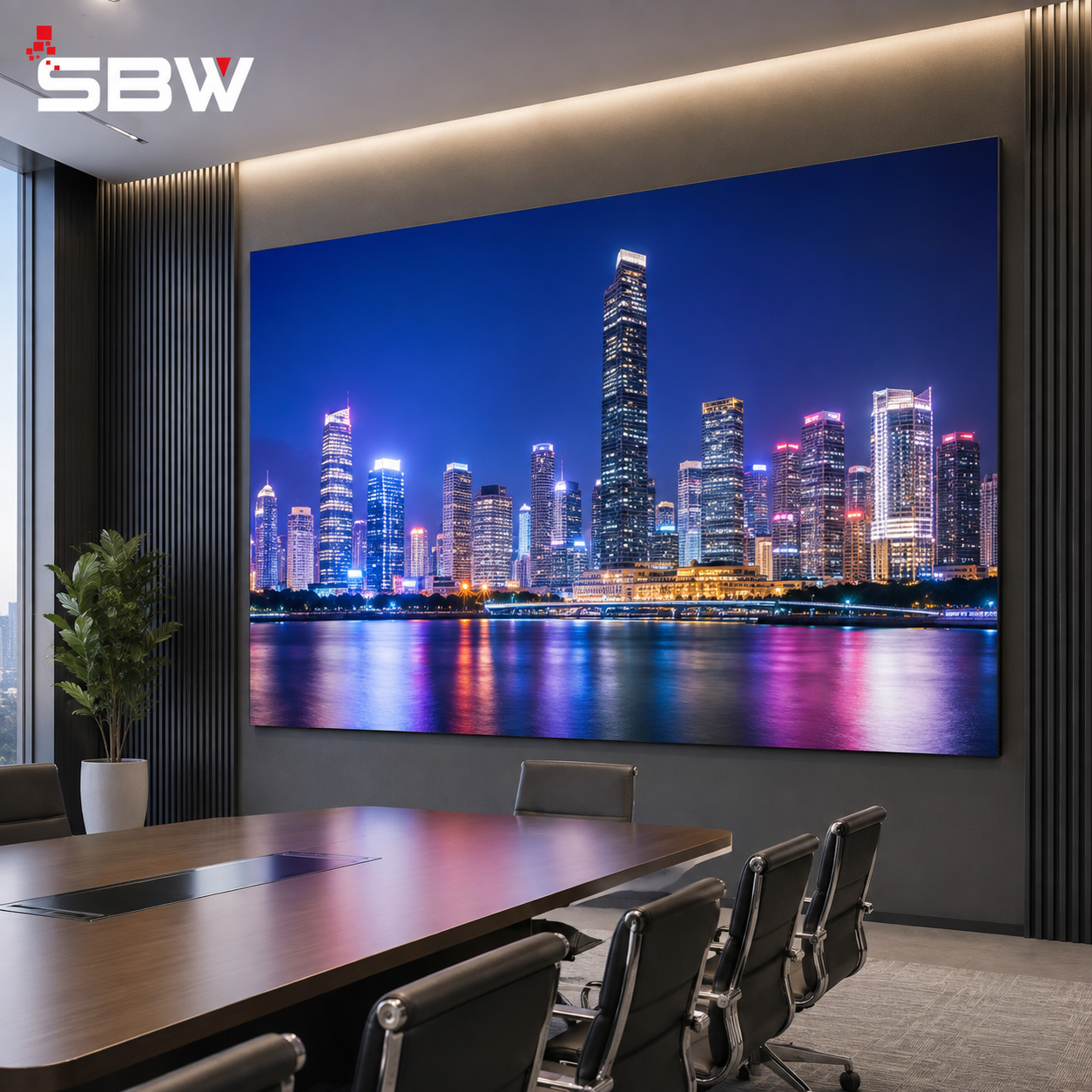 | Fine Pitch LED Display SBW Technology Private Limited offers Fine Pitch LED Displays designed for applications that require exceptional image clarity, sharp details and... View product → |
How can you make the final worth-it decision for your office?
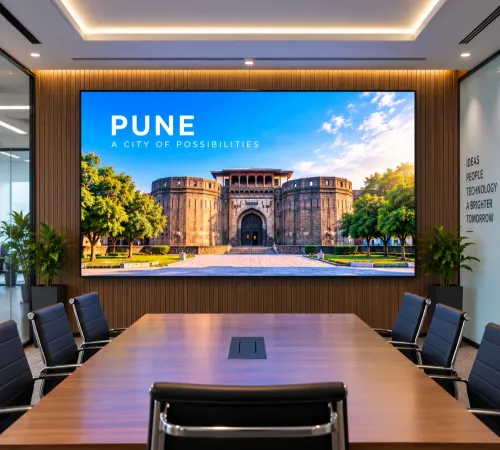
Approve the wall only after an on-site demonstration using the proposed cabinet size, processor and content sources. For a fine pitch LED display for office in Pune, mark the nearest normal seat and check the image from that distance, from the room’s sides and while standing.
A wall that looks oversized at the nearest seat wastes money, while a small wall forces unreadable text and crowded layouts.
Test these items before signing acceptance:
- Display the smallest text, spreadsheets, presentation slides and graphics your team will use; check letter edges, scaling and fine lines at native resolution.
- Show a black screen, dark video and grey test patterns; inspect module-to-module brightness, colour, dark-level uniformity, cabinet alignment, dead pixels and stuck pixels.
- Walk across the room and look for seams, brightness shifts and visible scan artefacts. A seamless surface is valuable only when alignment remains invisible.
- Run the actual meeting camera, conferencing platform and shutter settings; check for banding, flicker and moiré rather than trusting the refresh-rate figure.
- Feed the planned 4K sources and confirm how the controller maps them to the wall’s native pixel dimensions.
The fine pitch display benefits justify purchase when the tested canvas improves presentations, signage or collaboration every week. Reject the proposal if the room needs only a small 16:9 image, text remains unclear, or the acceptance criteria are missing from the contract.
Frequently asked questions
How should you choose pixel pitch for an office viewing distance?
Use the nearest normal viewer as your starting point. A practical approximation is that minimum comfortable viewing distance in metres roughly equals pixel pitch in millimetres, so a 1.2 mm display suits viewers from about 1.2 metres away. Check the planned seating, walking paths, and presentation positions before choosing a tighter pitch.
When does fine pitch LED beat LCD, flat panels or a projector?
Fine pitch LED is strongest when you need a large seamless image, high brightness, flexible aspect ratios, and frequent long-duration use. LCD video walls offer lower entry cost but have bezels and panel replacement needs. Projectors need controlled lighting, projection distance, and screen space, while LED performs better in bright rooms.
Which benefits justify the premium, and which trade-offs reduce its value?
The premium is easier to justify when the wall is large, viewed up close, used daily, or central to client presentations and monitoring. Trade-offs include higher purchase cost, power consumption, heat, calibration, specialist installation, and the need for serviceable spare modules.
What must you specify before installing an LED wall in a Pune office?
Specify pixel pitch, wall dimensions, cabinet and module format, brightness, refresh rate, colour performance, viewing angle, front or rear service access, power supply, control processor, input signals, mounting structure, ventilation, electrical capacity, warranty, spare parts, and local service response time.
How can you make the final worth-it decision for your office?
Compare the installed cost and operating requirements with the value of seamless scale, visibility, uptime, and presentation impact. Choose fine pitch LED when those benefits matter more than the lower initial cost and simpler maintenance of LCD panels or a projector.